Build

I design products.AI agents build them.

Projects built with AI
13+
Agents and steps designed in the last two months
18
02

My agents

  • AI does it
  • I decide
  • Goes in or out
03

What I've built

01

La Fábrica

A creative agency staffed by seven AI employees: it takes an idea from the first meeting to a live website in days, with just three human decisions along the way.

Since October 2026 · With clients

Problem

A good website takes weeks and a lot of back-and-forth between strategy, copy, design and code. I wanted to see if a team of agents could do that work at a studio's level, with me making only the calls that matter.

Architecture

Each stage is an agent with its own rules. I sign off at three moments: the plan, the design and the launch. Without my approval, the system doesn't move forward.

01 · In / out A client comes in 02 · AI Learns the business 03 · AI Researches the market 04 · AI Writes the proposal 05 · Me I approve the plan 06 · AI Writes the copy 07 · AI Designs two versions 08 · Me I pick the design 09 · AI Codes the site 10 · AI Reviews it closely 11 · Me I sign off,it goes live

Product decisions

  1. 01 Human-in-the-loop

    Three approval gates, written into the system

    Why. AI handles the volume; I decide where a mistake costs the client: the plan, the design and the launch. Without my approval, the system won't move.

    Trade-off. Slower than a fully automatic pipeline. In exchange, nothing reaches a paying client without me seeing it.

  2. 02 Jobs to be done

    Two tracks, based on the job the client needs done

    Why. A business that wants to be found doesn't need what one that wants to sell does: marketing runs on Astro and Cloudflare; e-commerce, on Shopify.

    Trade-off. Maintaining two stacks and two rulebooks, instead of forcing a single template.

  3. 03 Hick's law

    Two full directions and one recommendation

    Why. More options slow the decision down. I used to show three and choosing was hard; with two, complete and in motion, clients choose without having to design.

    Trade-off. Less exploration out loud: the culling happens earlier, inside the system.

  4. 04 Maker–checker

    Whoever reviews can't fix

    Why. The reviewer agent arrives with no context on who did the work and has no write tools: it only reports. No one grades their own work.

    Trade-off. One more round per handoff: every finding goes back to its maker.

Proof

P1Client deliverables

Pez de SelvaColombia · handmade necklacesDesign chosen · launching in December
  • The necklaces, made of beads that scatter under the cursor and rebuild into the next piece.

  • The home page they chose: the jungle draws itself and the headline arrives letter by letter.

Lolli GelatoMadrid · gelato shopDirection presented Nov 18
  • The entrance: one unbroken line draws the logo, fills with pink, and the mascots jump out.

Centro Auditivo Astrid GonzálezDuitama · audiology6-page prototype approved
  • As you scroll, the video shrinks into the shape of the ear in the logo.

P2Under the hood

4
agentsintake · designer · builder · reviewer: they cover the team's 7 roles
11
skillsstrategy, brand, copy, design…
8
data schemasevery handoff is validated
2
control hooksnothing moves if they fail
1
publish gateopens only on my yes

Tech stack

AI & agents
Claude CodeClaude OpusSubagentsSkillsHooksCloud sessions
Workflow & quality
GitHubPR por etapaNode.jsJSON SchemaAJVjs-yamlPythonPlaywrightLighthouse
Web
AstroTailwind CSSGSAPCanvas 2D
Commerce
ShopifyLiquidShopify CLI
Hosting
Cloudflare PagesVercel

P3Code

web-factory/agents/reviewer.mdChosen excerpt · full code in an interview

A reviewer that can't fix things

What it does

  1. Each agent is defined in a file: its model, its role and the tools it may use.
  2. The reviewer gets no write tools (only read, search and run checks): it can't “fix” what it reviews, only report it.
  3. It arrives with no context about who did the work, so no one grades their own.
---name: reviewerdescription: Independent reviewer with a clean context. Reviews copy against the brief  and the built theme against the approved direction and QA results.  Never fixes anything; only reports.tools: Read, Glob, Grep, Bash     # no Edit, no Writemodel: opus--- You did not take part in producing what you review and you must not fix it.Your value is in catching regressions and gross errors against what was approved,not in judging taste; taste is Santi's job at his checkpoints. First run `node .claude/scripts/validate.mjs . pages`. Every length-limit orstep-list error it prints is a `blocking` finding.
web-factory/scripts/deploy-prod.shChosen excerpt · full code in an interview

Nothing ships without my yes

What it does

  1. Before publishing, the script reads the project's state.
  2. If my approval isn't written there, it stops; and agents are denied from running it at all.
  3. Then it validates every project contract in strict mode.
# HARD GATE: refuses to run unless project.json.approvals.launch === true AND state === "live".# Only Santi sets approvals.launch. Agents are denied from running this script. LAUNCH="$(node -e 'const p=require("./project.json"); process.stdout.write(String(p.approvals && p.approvals.launch === true))')" if [ "$LAUNCH" != "true" ]; then  echo "REFUSED: approvals.launch is not true for $CLIENT_SLUG. Santi must approve staging first." >&2  exit 1fi # contracts must be valid before anything shipsnode "$(dirname "${BASH_SOURCE[0]}")/validate.mjs" . --strict

Results

Clients in Madrid and Colombia: Lolli Gelato, Pez de Selva and Centro Auditivo Astrid González. The first launch is planned for December 2026.
02

Seed

A platform that helps independent artists fund their careers through their fans.

3 weeks · Live

Problem

Independent artists fund their tours out of pocket or depend on a label. Their fans want to back them, but there's no clear way to do it and get something back.

Architecture

The fan arrives from an Instagram story, meets the artist, creates an account and saves their spot as a founding backer. I read the whole funnel to see what works.

01 · In / out Instagram story 02 · Step Artist page 03 · Step Creates an account 04 · Step Saves their spot 05 · In / out Founding backer #N 06 · Me I read the funnel

Product decisions

  1. 01 Regulatory risk

    From investing to backing

    Why. It started as investing in the artist's business. Offering investments to the public carries a heavy legal cost just to validate an idea, so I moved to pledges with no charge.

    Trade-off. A pledge is a weaker signal than a payment, but it can be tested now and without lawyers.

  2. 02 Riskiest assumption test

    Measure what people do, not what they say

    Why. The riskiest assumption was whether a fan would put down their name and an amount. So the test asks for a real action: create an account, pick a stop and an amount, save the spot.

    Trade-off. Every extra step drops people from the funnel; the numbers come out lower, but honest.

  3. 03 Channel-first

    Built for Instagram's in-app browser

    Why. Almost all traffic arrives from an Instagram story, so that's the product: it loads in under 2 seconds and doesn't ask for Google sign-in, which breaks inside that app.

    Trade-off. Fewer sign-in options for anyone arriving from elsewhere.

  4. 04 Scarcity and social proof

    50 numbered founding spots

    Why. A number (“founding backer #12”) and a visible cap (“34 of 50 left”) turn abstract support into a concrete spot you could lose.

    Trade-off. A low cap limits how much demand a single tour can measure.

  5. 05 Success metrics set before the test

    Thresholds were set before launch

    Why. The internal dashboard checks every funnel step against a threshold set in advance, so the conclusion can't bend to fit the results.

    Trade-off. If a threshold was set wrong, so is the test; that's why they're written and argued up front.

Proof

P1The fan funnel

  1. 01The home page

    The record spins and changes artist; the tonearm shows how far along the raise is.See it live →

  2. 02The tour

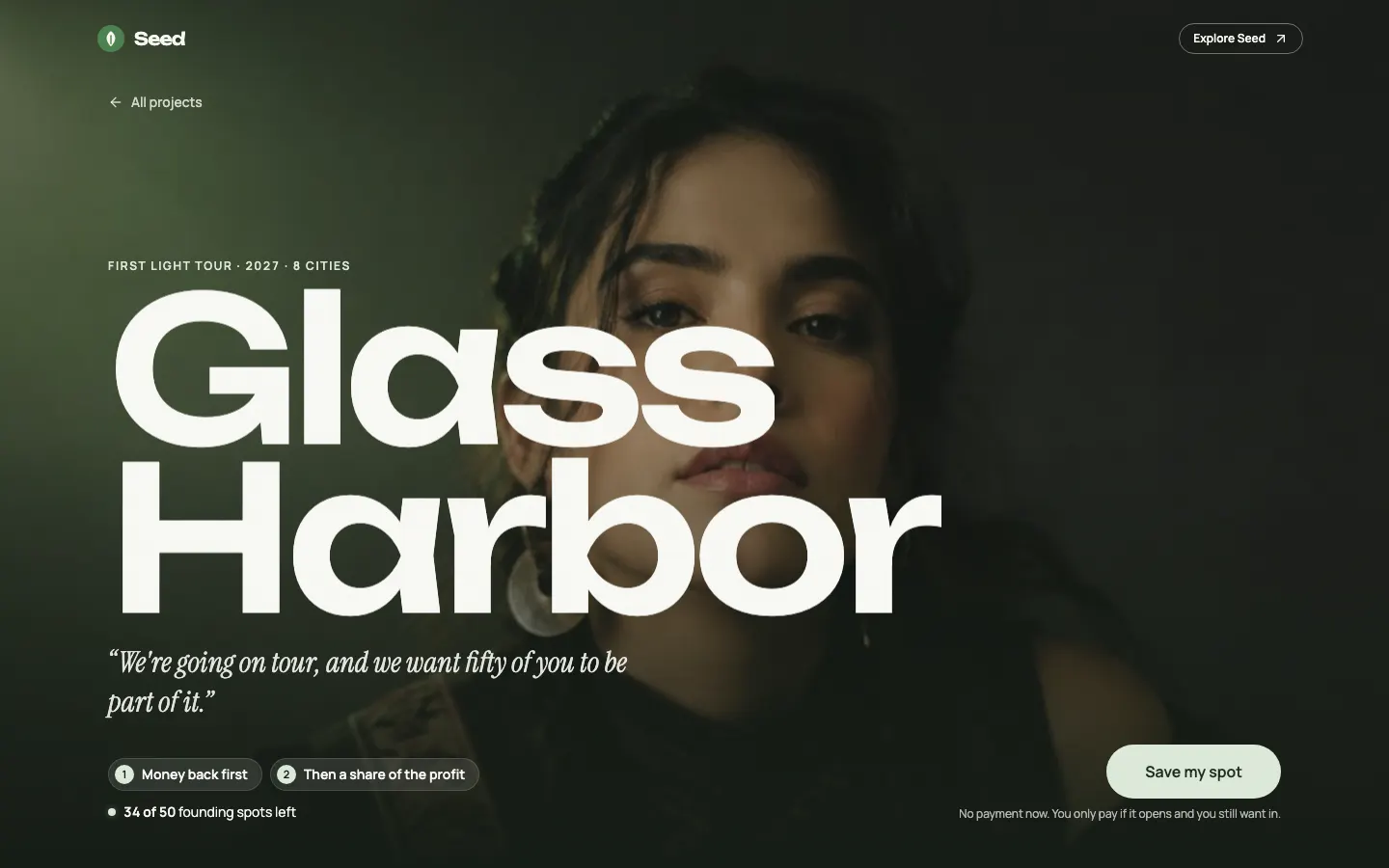
    50 founding spots: money back first, then a share of the profit.

    50 founding spots: money back first, then a share of the profit.See it live →

  3. 03The artist

    Pops up on video and speaks to the fan, with captions.See it live →

  4. 04The founding backer

    Saving a spot gives the fan their number. Sample data.

P2Under the hood

Tech stack

Frontend
TypeScriptReact 19TanStack StartTanStack RouterTanStack QueryViteNitro (SSR)Tailwind CSS 4shadcn/uiRadix UIMotionLenisZodReact Hook Form
Backend & data
SupabasePostgresPL/pgSQLRow Level SecuritySupabase AuthSupabase StorageResend
Tooling & hosting
VercelbunLovableClaude Code

P3Code

supabase/migrations/…_waitlist.sqlChosen excerpt · full code in an interview

50 spots, zero duplicate numbers

What it does

  1. Signing up is a single database operation: it locks the tour, checks, assigns the number and saves, all or nothing.
  2. If two fans tap the button in the same second, they never get the same number and the cap is never exceeded; sign up twice and you get your own number back.
  3. The browser can't call it: only the server has permission.
-- Lock the tour row: concurrent sign-ups wait in line instead of racing.PERFORM 1 FROM public.campaigns c WHERE c.id = p_campaign_id AND c.status = 'live' FOR UPDATE;IF NOT FOUND THEN RAISE EXCEPTION 'campaign_not_live' USING ERRCODE = 'P0001'; END IF; -- Already on the list? Give them their number back instead of a duplicate.SELECT * INTO v_existing FROM public.waitlist_entries eWHERE e.campaign_id = p_campaign_id AND e.email_normalized = lower(btrim(p_email));IF FOUND THEN RETURN QUERY SELECT v_existing.id, v_existing.founding_number, true; RETURN; END IF; -- One atomic update hands out the next founding number, never past the cap.UPDATE public.campaigns c SET founding_taken = c.founding_taken + 1WHERE c.id = p_campaign_id AND c.founding_taken < c.founding_spotsRETURNING c.founding_taken INTO v_number; -- Only the server may call it; the browser never can.REVOKE ALL ON FUNCTION public.join_waitlist FROM PUBLIC, anon, authenticated;GRANT EXECUTE ON FUNCTION public.join_waitlist TO service_role;

Results

Live, with a sample tour and the first sign-ups from an Instagram test.

03

Automatic video editing

From an idea in my notes to a ready-to-post video. I just approve.

6 days · Runs on its own every hour

Problem

I have hundreds of ideas in my notes and thousands of clips on my phone, but putting each piece together took hours. I wanted to post more without losing my voice.

Architecture

It writes in my voice, finds the clips in my camera roll that tell each line, drops any that show faces and assembles the video. It runs on its own every hour.

01 · In / out An idea in my notes 02 · AI Writes in my voice 03 · Me I approve with an OK 04 · AI Picks the exact clip 05 · AI Drops any faces 06 · Step Cuts and color-grades 07 · Step Builds the video 08 · In / out Ready in my Drive

Product decisions

  1. 01 Zero friction

    Approval lives where I already work

    Why. No new apps: the script arrives as a document and I type “OK” on the first line. The system picks it up and keeps going.

    Trade-off. Less fine-grained control than a custom interface; in exchange, adoption is instant because there's nothing to learn.

  2. 02 Precision vs. recall

    When in doubt, the clip is out

    Why. In privacy, a false negative (a face slipping through) costs far more than a false positive (a good clip lost). Two filters, and if one clip shows someone, the whole scene goes.

    Trade-off. In its first week it dropped 73 clips and used 67: more than half went out of caution.

  3. 03 Weighted relevance (IDF-style)

    Search by meaning, rewarding the specific

    Why. Each line becomes visual concepts (“marathon” → running, sneakers, road) and a specific tag outweighs a generic one: “Running” counts more than “Outdoor”.

    Trade-off. No external models or cloud: it runs on the Mac, fast and private, but catches fewer nuances than a large vision model.

Proof

P1My content

The reels the system learns my voice from. I made these; the system writes like them.

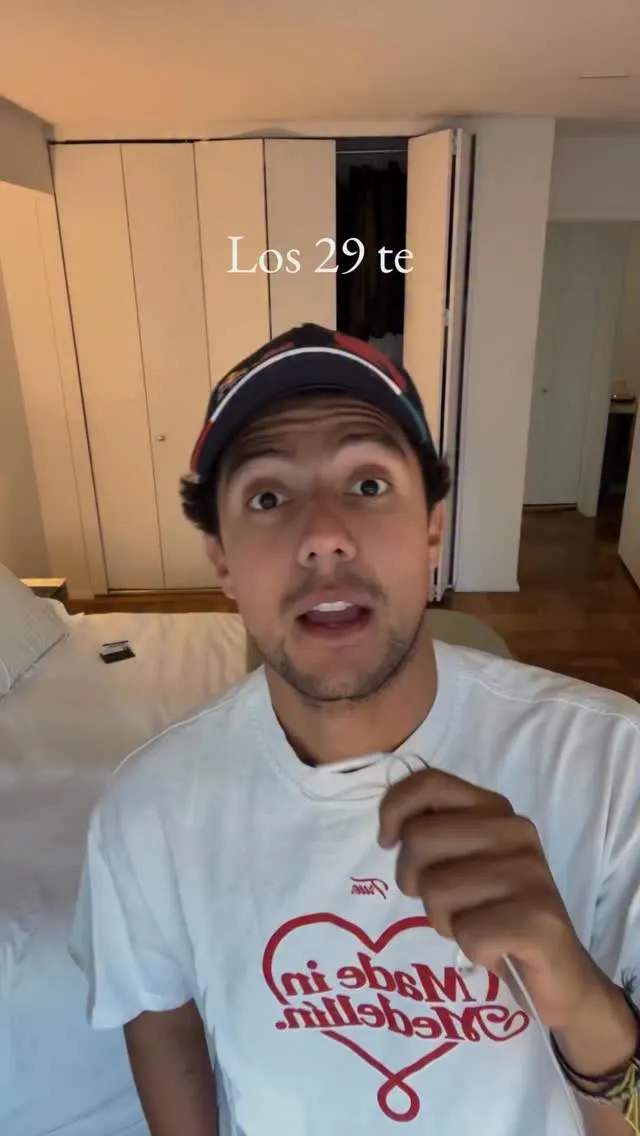
  1. Twenty-nine2,9M views
  2. Rejection (ft. Fred again..)825K views
  3. Running toward burnout797K views
  4. The gray area360K views
See my Instagram →

P2Under the hood

Tech stack

AI & vision
Claude CLI (claude -p)Apple VisionRanking tipo IDF
Mac & Apple
PythonPyObjCosxphotosiCloud PhotosJXAAppleScriptApple Noteslaunchd
Video & delivery
ffmpegPillowGoogle Drive APIOAuth 2.0

P3Code

carruseles-notas/verificar.pyChosen excerpt · full code in an interview

Computer vision, on the Mac itself

What it does

  1. It calls Apple's Vision framework from Python, without sending a single clip to the cloud.
  2. In one pass it runs four detectors on every frame: faces, bodies (even from behind or in silhouette), a scene classifier and text recognition.
  3. If any of them sees people or burned-in text, the clip stays out of the video.
import Visionfrom Foundation import NSURL def analizar(img, con_texto=True):    handler = Vision.VNImageRequestHandler.alloc().initWithURL_options_(NSURL.fileURLWithPath_(str(img)), None)    caras   = Vision.VNDetectFaceRectanglesRequest.alloc().init()    cuerpos = Vision.VNDetectHumanRectanglesRequest.alloc().init()    cuerpos.setUpperBodyOnly_(False)                 # de espaldas, lejos o en silueta    clases  = Vision.VNClassifyImageRequest.alloc().init()    texto   = Vision.VNRecognizeTextRequest.alloc().init()    texto.setRecognitionLevel_(Vision.VNRequestTextRecognitionLevelAccurate)     handler.performRequests_error_([caras, cuerpos, clases] + ([texto] if con_texto else []), None)     personas = sum(1 for r in cuerpos.results() or [] if r.confidence() >= PERSONA_CONF)    for r in clases.results() or []:               # «people», «crowd», estatuas…        k, c = str(r.identifier()), r.confidence()        if (k in GENTE and c >= GENTE_MIN) or (k in ESTATUAS and c >= ESTATUA_MIN):            personas = max(personas, 1)    n = sum(1 for r in caras.results() or [] if r.boundingBox().size.width * r.boundingBox().size.height >= CARA_MIN)    return n, personas

Results

It has built 45 pieces so far, and 15 are live. In its first week it used 67 clips and dropped 73, 42 of them for showing people.


04

Lab

Smaller projects: experiments, tools I built for myself and tests that taught me something.

  • AI personal trainer Agents from Nikita Vovchenko's open-source coach plugin plan training and nutrition; my app turns it into a visual guide. The session guide: each exercise moves on its own card, you tick off sets and the clock runs the rest.
    2026 1 day
  • Expense tracker My Apple Pay, bank and statement spending in one ledger, across currencies. The dashboard, with made-up spending: what's left to review, across currencies, and the month's budget.
    2026 ~1 month
  • Media news agent A daily media-industry briefing, in Telegram and Slack. Its real runs on GitHub: 103 mornings since July, without me touching it.
    2026 ~1 week
  • Media kit My bilingual media kit, with protected rates and a PDF. The media kit, which now lives on the Create side.Open →
    2026 3 days